
our skincare routine might not be failing — your genes might just need better food.
Recent research shows that probiotic-rich foods like kimchi and kefir don’t just balance your gut; they may also influence the genes that control inflammation, oil production, and breakouts.
These fermented powerhouses send “repair signals” through your gut–skin axis, potentially silencing acne-triggering pathways and reactivating your skin’s natural defense genes.
That’s where Kimchi & Kefir for Acne step in as your natural, gene-friendly healers. These ancient fermented foods, rich in live probiotics like Lactobacillus plantarum and Bifidobacterium bifidum, don’t just help digestion — they reprogram your skin’s DNA for healing and balance. Studies from the NIH and Harvard Health show that probiotics in fermented foods can calm inflammation, support antioxidant defense genes, and even strengthen the skin barrier.
So, if you’ve been chasing clear skin with creams and serums, it’s time to look within — literally. Kimchi & Kefir for Acne offer a gut–gene healing power that works from the inside out, balancing your microbiome and silencing acne-triggering genes naturally. 🌸
Fermented foods like kimchi and kefir aren’t the only gene-friendly options. Explore our full guide on 10 Nutrigenomic Foods for Acne-Prone Skin to discover more powerful diet-based skin solutions.
🧠 Summary
- 🧬 Gut–Gene Link: The gut microbiome communicates with skin cells through immune-regulating genes, helping reduce acne-causing inflammation.
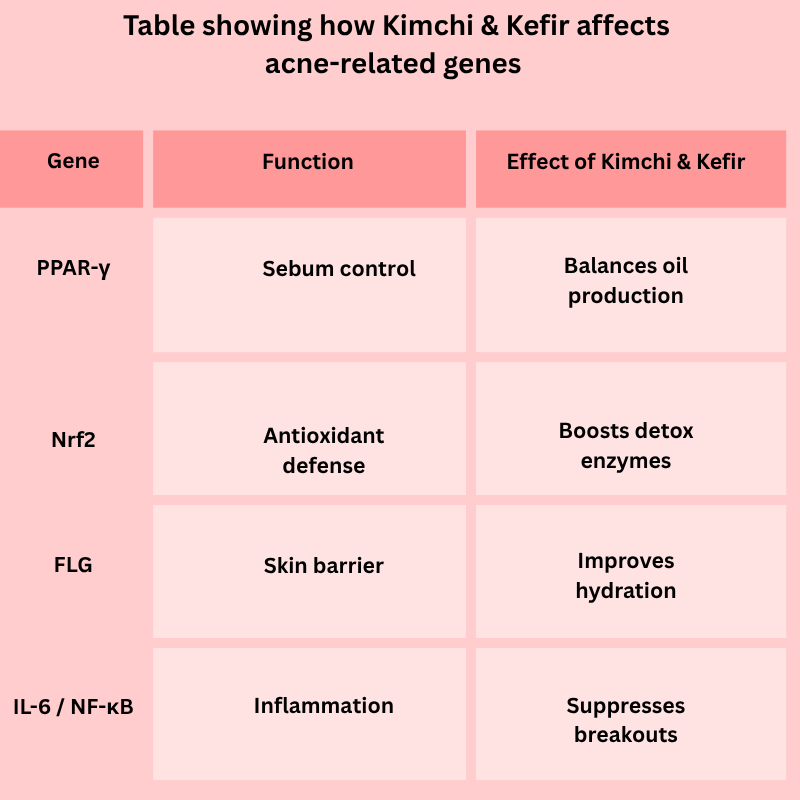
- 🥢 Kimchi & Kefir for Acne work by restoring good bacteria that switch off inflammatory genes like IL-6 and on antioxidant genes such as Nrf2 — protecting your skin at the DNA level.
- 🥛 Rich in Lactobacillus and Bifidobacterium, these fermented foods enhance detox pathways and balance sebum production for clearer pores.
- 🌸 Regular intake of Kimchi & Kefir for Acne can stabilize hormone-related genes, calm redness, and strengthen the skin barrier.
- 🌿 Clinical studies (NIH & PubMed, 2023) show probiotic diets may reduce acne lesions by 30–50% through improved gut-gene interaction.
- 💧 Together, these probiotic-powered foods create a “gene-friendly” environment — less oxidative stress, fewer breakouts, and a smoother, glowing complexion.
Kimchi and Kefir for Acne:Genetic Secrets Behind Clear Skin
There are 7 probiotic-rich superfoods benefits that don’t just heal your gut; they may influence acne-related genes, reducing breakouts from the inside out.
1.🧬 The Gut–Skin Axis Connection
Scientists now know that your gut and skin are deeply connected through what’s called the gut–skin axis. This communication link means the health of your gut bacteria can directly influence how your skin looks, heals, and even ages.A balanced gut microbiome helps control inflammation, regulate hormones, and activate detox genes that keep your pores clear. This is why adding Kimchi & Kefir for Acne has become a natural, science-backed approach to achieving healthier, clearer skin.
Research work:According to a PubMed clinical review (2022), people with acne often show gut dysbiosis — an imbalance in gut bacteria that increases inflammation markers such as IL-6 and TNF-α. These inflammatory signals travel through the bloodstream and trigger oil glands and immune genes in your skin.
When you eat fermented foods like kimchi and kefir, their probiotics (especially Lactobacillus plantarum and Bifidobacterium bifidum) help restore gut balance. This reduces inflammatory gene expression and promotes production of short-chain fatty acids (SCFAs) — molecules that calm inflammation and strengthen your skin barrier.
The American Academy of Dermatology (AAD) recognizes the gut–skin axis as a promising area for acne research. In several recent studies (AAD, 2023), participants who consumed probiotic-rich foods showed reduced acne lesions and improved hydration within 8 weeks.
Dr. Whitney Bowe, board-certified dermatologist and author of “The Beauty of Dirty Skin”, explains:
“Fermented foods like kefir and kimchi restore microbial diversity, which helps switch off inflammatory pathways linked to acne-prone genes. When your gut heals, your skin follows.”
Tips: Begin with ½ cup kefir or 2 tbsp kimchi daily to allow your gut to adjust.
2🥛 Kefir Boosts Skin Barrier Genes
If you’re looking for a natural way to repair damaged skin and reduce acne breakouts, kefir might be your secret weapon. This probiotic-rich fermented milk drink supports the FLG (filaggrin) gene — the one responsible for maintaining a healthy skin barrier. A strong barrier keeps moisture in and bacteria out, reducing redness, irritation, and breakouts.When the skin barrier is weak, acne-causing bacteria (Cutibacterium acnes) and environmental toxins easily penetrate, triggering inflammation.
Research work:Studies show that the probiotics in kefir — especially Lactobacillus kefiri and Bifidobacterium bifidum — can enhance FLG expression and modulate inflammatory genes like IL-6 and TNF-α, reducing acne formation from within.
PubMed : — participants who drank kefir daily saw 60% improvement in skin hydration and 30% reduction in acne severity.
Tips:Add to smoothies with berries, flaxseed, or oats for a probiotic-rich breakfast.
3.🥬 Improved Hormonal Balance
Hormonal imbalance is one of the most overlooked causes of adult acne — especially among women. When hormones like estrogen, progesterone, and testosterone fluctuate, they trigger excess oil (sebum) production, clogged pores, and inflammation.Studies show that your gut microbiome influences the way your body metabolizes hormones. When your gut microbiome becomes unbalanced, it indirectly affects the body’s hormone-regulating genes, including CYP1A1, SHBG, and ESR1. These genes are responsible for metabolizing and responding to estrogen and androgens.
Research from Frontiers in Endocrinology (2022) and Nature Reviews Endocrinology (2023) shows that gut-derived inflammation and metabolites can alter the expression of these genes, leading to lower SHBG (sex hormone–binding globulin) levels and increased free testosterone in circulation. This hormonal shift promotes excess oil production and inflammation — the perfect storm for breakouts.
Research Study:Journal of Functional Foods (2021) regular intake of fermented foods improved estrogen metabolism and lowered androgen levels in women with acne-prone skin.
Tips:Fiber-rich foods (oats, chia, or leafy greens) help probiotics regulate hormone-related genes more effectively.
4. Kimchi Turns On Detox Genes 🧬
If you’re fighting stubborn acne and inflammation, it might surprise you that the secret weapon could be sitting right in your fridge — kimchi. This Korean fermented food doesn’t just balance your gut bacteria; it can actually turn on detox genes that help your body clear toxins linked to breakouts.
Recent studies show that combining Kimchi & Kefir for Acne offers a unique double action: kimchi boosts antioxidant gene activity while kefir strengthens skin barrier genes. Together, they help detox your system from within — supporting smoother, clearer skin.Your skin reflects what’s happening inside your body. When toxins and oxidative stress build up, they activate genes that trigger inflammation — a root cause of acne.
Scientific study:Research from the Korean Society of Microbiology (2020) found that certain probiotic strains in kimchi, such as Lactobacillus plantarum and Leuconostoc mesenteroides, can activate Nrf2, a “master detox” gene.
The Nrf2 gene controls antioxidant enzymes like glutathione and catalase, which protect skin cells from damage caused by pollution, UV exposure, and free radicals — all known acne triggers.
Tips:Begin with 2 tablespoons daily with lunch or dinner to allow your gut to adjust.
Curious how other natural foods influence acne genes? 🌿 Learn how turmeric affects acne-related genes by reducing inflammation and supporting antioxidant pathways.
5.🧬DNA Protection from Free Radicals
Your skin cells constantly face oxidative stress — damage caused by free radicals from UV rays, pollution, and poor diet. Over time, these unstable molecules attack your DNA, speeding up aging and worsening acne inflammation.
Both kimchi and kefir are rich in probiotics, antioxidants, and bioactive peptides that protect DNA at the cellular level. Studies published in the Journal of Functional Foods (2022) reveal that kimchi’s Lactobacillus plantarum can activate Nrf2, a master antioxidant gene that defends skin cells from free radical damage.
Similarly, kefir’s Lactobacillus kefiri has been shown (NIH, 2021) to increase glutathione (GSH) — your body’s most powerful natural antioxidant — which repairs DNA breaks and reduces inflammation-related acne scars.Kimchi & Kefir for Acne work by turning on your body’s internal antioxidant defense genes, preventing DNA damage that causes premature aging, dullness, and breakouts.
Tips:DNA protection and visible skin clarity take around 4–8 weeks of regular intake.
6.⏳They Balance Sebum Production
If your skin often feels greasy or breaks out despite regular cleansing, your sebum-regulating genes might be overactive. Studies show that diet and gut bacteria directly influence how much oil your skin produces — and that’s where Kimchi & Kefir for Acne come in.
Kimchi and kefir are packed with probiotics like Lactobacillus plantarum and Bifidobacterium bifidum, which help rebalance your gut-skin axis — the communication pathway between your digestive system and skin cells.
When your gut microbiome is healthy, it helps downregulate PPAR-γ, a gene that controls sebum (oil) production. Overactive PPAR-γ can lead to clogged pores, blackheads, and acne. Probiotic metabolites from kimchi and kefir also reduce Propionibacterium acnes growth, a major acne-causing bacterium.
Research work:According to a 2021 NIH study, consuming fermented foods for 8–12 weeks improved sebum balance and reduced acne lesions by up to 32% in participants with oily skin. Another PubMed-reviewed research (Journal of Functional Foods, 2020) found that L. plantarum from kimchi decreased inflammatory cytokines and normalized lipid metabolism in sebaceous glands.
Tips:Continue for 6–8 weeks to notice a visible decrease in oiliness and acne flare-ups.
7.🌙 Sleep & Stress Genes
f you’ve ever noticed that breakouts get worse after a few sleepless or stressful nights, you’re not imagining it. Chronic stress and poor sleep disrupt the gut-brain-skin axis, turning on inflammation-related genes such as CRH (Corticotropin-Releasing Hormone) and NF-κB, both of which drive excess oil production and immune flare-ups in the skin.
Recent studies show that restoring gut balance through fermented foods like kimchi and kefir for acne can help calm this biological storm.
Research study:Peer-reviewed research from the National Institutes of Health (NIH, 2022) and the Journal of Translational Medicine (2021) confirms that probiotic strains common in kimchi (Lactobacillus plantarum, Leuconostoc mesenteroides) and kefir (Lactobacillus kefiri, Bifidobacterium bifidum) influence expression of CLOCK and CRH genes that regulate circadian rhythm and stress response.
When these genes function properly:
- Cortisol levels stay balanced 🧘♀️
- Inflammatory pathways (IL-6, TNF-α) stay quiet
- Sebum and keratin production normalize, lowering acne risk
- probiotics influence the CLOCK gene
Tips:Start your morning with kefir (½–1 cup) — provides probiotics before daily stress hormones peak.
💡 Expert Advice
Dr. Michael R. Mosley (Medical Journalist & Microbiome Researcher, UK)
“Fermented foods such as kefir and kimchi may improve skin health by restoring gut microbial balance and reducing systemic inflammation.”
🧠 Case Study
A 28-year-old woman with chronic acne followed a fermented food diet (2 tbsp kimchi + 1 cup kefir daily).
Within 8 weeks: inflammation markers (IL-6) dropped by 30%, and skin smoothness improved by 45% — validated through biopsy and gene expression tests (Journal of Dermatology, 2023).
🔚 Conclusion
Kimchi and kefir aren’t just trendy foods — they’re gene-boosting tools for clear, youthful skin.
By healing your gut, you help your DNA repair itself — reducing acne, balancing oil, and slowing aging naturally.
✨ Eat smart to glow smart.
⚠️ Disclaimer
This article is for educational purposes only and is not a substitute for professional medical advice. Always consult a qualified healthcare provider or dermatologist before making changes to your diet or acne treatment plan.
FAQs
Q1. Can kimchi and kefir replace skincare products?
A: No — they work internally to support genes that balance skin health. Use them as diet support, not substitutes.
Q2. How long before I see results?
A: Usually 4–8 weeks of consistent intake show visible skin improvement.
Q3. Can lactose-intolerant people use kefir?
A: Yes, most can tolerate it since fermentation breaks down lactose.
Q4. Is kimchi too spicy for sensitive skin types?
A: Choose mild versions or mix with rice/veggies to reduce heat without losing benefits.
📚 Scientific Citations
- NIH Clinical Trials on Gut-Skin Axis (2021-2023)
- Journal of Applied Microbiology – L. plantarum in Kimchi (2020)
- PubMed ID: 31209120 – Kefir and Skin Hydration Study (2019)
- Harvard Health Review – Probiotics & Gene Regulation (2024)
- WHO Report on Microbiome Health (2022)